The Ultimate Personality Test
Where Science Meets Self-Discovery
Get insights and personalized recommendations from 4 personality frameworks in one scientifically-designed test. Discover your Big Five, Enneagram, Jungian Type (Briggs/Myers style), and Personality Cluster.
100% free • Instant results
What Makes This Test Special?
Get comprehensive insights from the four most comprehensive personality frameworks in psychology.
Scientifically Designed
Based on data-driven psychological research and tested with 300,000+ participants
Compare with Friends
Share results with friends for detailed personality comparisons
Personalized Insights
Get tailored recommendations for career, relationships, and personal growth.
Watch our founder break down the psychological research that inspired our unique four-in-one personality test.

Four Frameworks. One Complete Picture.
The three most popular personality frameworks in psychology, plus our exclusive new framework.
Big Five
The gold standard in academic psychology. Measures your levels of Openness, Conscientiousness, Extraversion, Agreeableness, and Neuroticism.
Enneagram
Explores nine personality types based on core motivations and fears. Popular for personal development and self-understanding.
Jungian Type
Inspired by MBTI, categorizes personalities across four dimensions: Extraversion/Introversion, Sensing/Intuition, Thinking/Feeling, Judging/Perceiving.
Personality Cluster
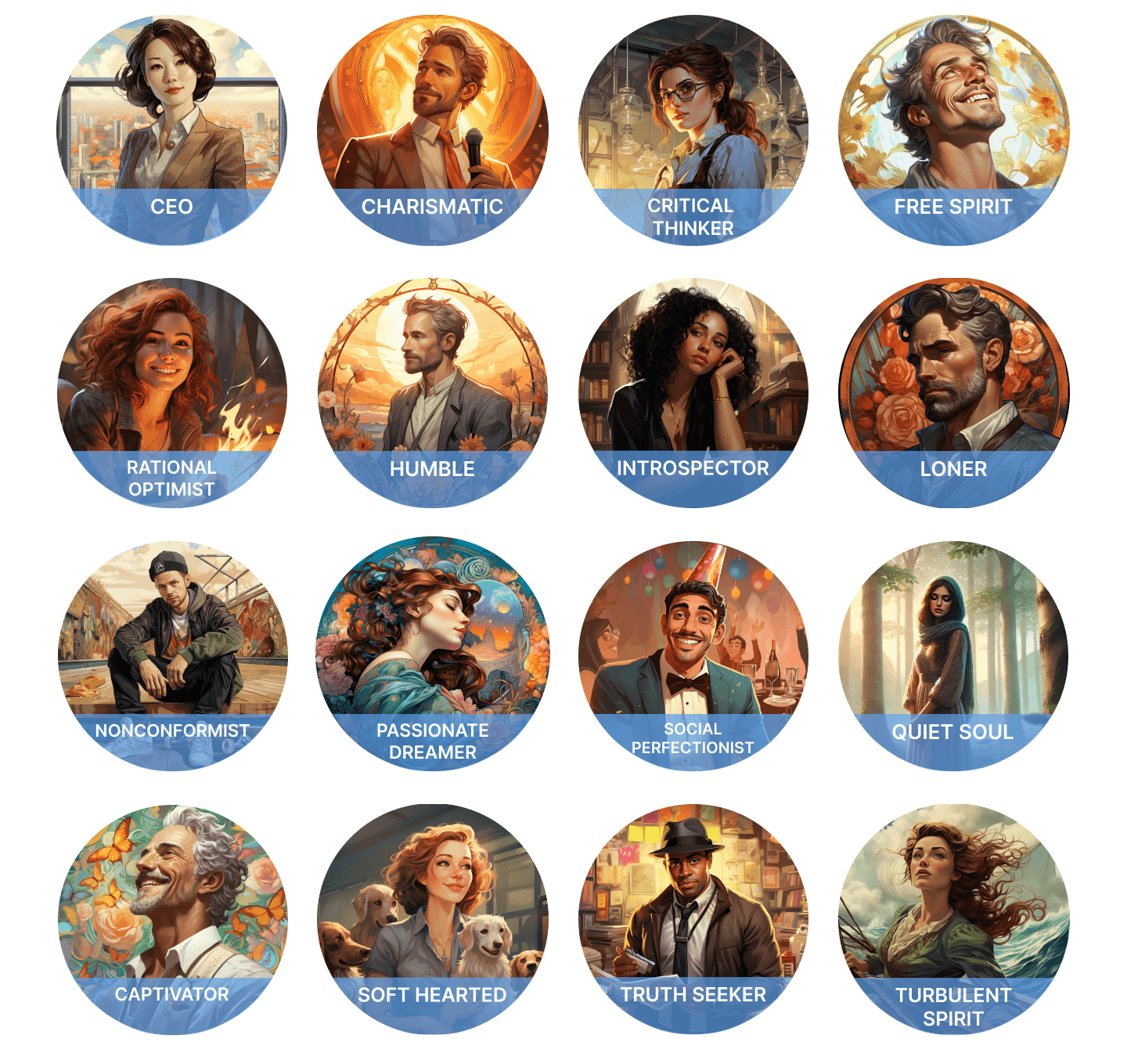
Our exclusive framework. Categorizes you into one of our 16 unique personality types based on statistical analysis.
Meet Your Potential Personality Types
Our exclusive Personality Cluster framework identifies you as one of these 16 unique types:
By proceeding you're agreeing to our TOS and Privacy Policy. Click here to learn more.
As you make progress through our programs, we save data about your choices for you in our database. We will never share data about your usage of our programs in combination with any of your personally identifying information, unless you explicitly give us permission to do so. We may use some data in aggregate – that is, in combination with other user information without any means of identifying you specifically – for research purposes. For example, we may use your fully anonymized data (aggregated with data from other users) as part of a research study which we may release or publish the results of.
If you are too young to agree to our Terms of Service or Privacy Policy in your country (under 16 in the European Region), please ask your guardian to click the button below on your behalf before continuing to use ClearerThinking.org.
Some third party companies that perform automated services for us (e.g. Google, as part of their Google Analytics service) may store your personal information, but they do not have permission to use or disclose this information for any purpose other than to render their services to us.
E.U. Citizens: Please note that your data will be stored outside of the European Union, including potentially in the U.S. and in other countries where we may have servers or databases.
For privacy and usage details, please check out our Terms of Service and Privacy Policy .
If you would like a copy of the information collected during your use of one of our programs, or would like to request that we delete your data for that program, please email us at info@clearerthinking.org and indicate the name of the program you used, along with sufficient information enabling us to identify which user is you (so we can provide or delete the correct data).
Last updated: May 25th, 2024.
Ready to Discover Your Personality?
Join over 300,000 people who have already uncovered their unique personality insights. Your journey of self-discovery starts here.
100% free • Instant results
More about Personality Tests and Personality Charts
A deep dive into the most popular personality frameworks — what they measure, where they came from, and which works best.
What are the most famous personality tests?
The top three most globally-recognized general personality frameworks are:
- MBTI (Myers-Briggs Type Indicator): with over 30 million Google search results
- Enneagram: with over 11 million search results
- Big Five: with over 4 million search results.
What is the MBTI?
The MBTI is an extremely popular personality test that classifies people into 16 types, based on how they perceive the world and make decisions. This test divides each person along four binary dichotomies:
- Extraversion (E) vs. Introversion (I)
- Sensing (S) vs. Intuition (N)
- Thinking (T) vs. Feeling (F)
- Judging (J) vs. Perceiving (P).
What are the personality types in this system? Each trait contributes a letter to a person's type, leading to 16 total types of personalities:
- ISTJ - The Inspector
- ISTP - The Crafter
- ISFJ - The Protector
- ISFP - The Artist
- INFJ - The Advocate
- INFP - The Mediator
- INTJ - The Architect
- INTP - The Thinker
- ESTP - The Persuader
- ESTJ - The Director
- ESFP - The Performer
- ESFJ - The Caregiver
- ENFP - The Champion
- ENFJ - The Giver
- ENTP - The Debater
- ENTJ - The Commander.
What is the Big Five?
The Big Five is the leading personality framework used by social scientists and psychologists in academia. It scores people on five traits:
- Openness — related to being imaginative, creative and intellectual
- Conscientiousness — about being orderly, organized, hard-working and rule abiding
- Extraversion — on being social, friendly, energetic, and talkative
- Agreeableness — about being kind, empathetic, people pleasing and polite
- Neuroticism — related to being anxious, depressed, angry, emotionally volatile, and having low emotional-stability.
To develop the model, researchers compiled many descriptive words, such as "kind" and "anxious". They then used factor analysis to cluster similar words based on correlation (i.e., if you agreed that one word described you, you were likely to agree that another word did too). For example, since "outgoing" people also tended to describe themselves as "talkative", those terms were linked (due to this correlation) under the broader trait of Extraversion.
What is the Enneagram?
The Enneagram classifies people into nine interrelated types, each identified by a number and defined by unique motivations and fears. Developed in the 20th century by Bolivian philosopher Ichazo and Chilean psychiatrist Naranjo, the Enneagram is not widely used in academia, but many people report finding it a useful tool for self-reflection. The Enneagram is not to be confused with the "12 personalities test", as it uses nine categories, not twelve.
The nine Enneagram types are:
- Enneagram Type 1: The Reformer — they are thought to be orderly, conscientious, and neat. Think Angela Martin from the TV show the Office. This type is sometimes linked to Obsessive Compulsive Disorder (OCD).
- Enneagram Type 2: The Helper — they are thought to be kind, nurturing, empathetic, and never cruel. They often focus on relationships, where they may find it challenging to say no. Think Leslie Knope from the TV show Parks and Recreation. This type is sometimes linked to Dependent Personality Disorder.
- Enneagram Type 3: The Achiever — they are thought to be charming, socially confident, ambitious, and hard-working, but also potentially shallow and attention seeking. Think Gaston from Beauty and the Beast. This type is sometimes linked to Narcissistic Personality Disorder.
- Enneagram Type 4: The Individualist — they are thought to be artistic, poetic, creative, sensitive, self-critical, and full of intense emotions. Think Zuko from the Last Airbender. This type is sometimes linked to Borderline Personality Disorder.
- Enneagram Type 5: The Investigator — they are thought to be logical, intellectual, curious, and learning-oriented, but also can be unexpressive, monotone and can have obsessive focus on solo hobbies. Think Sherlock Holmes. This type is sometimes linked to Schizoid Personality Disorder.
- Enneagram Type 6: The Loyalist — they are thought to be shy, loyal, awkward and insecure. They may feel beholden to the opinion of others and fear being taken advantage of. Think Cogsworth (the butler turned into a clock) from Beauty and the Beast. This type is sometimes linked to Paranoid Personality Disorder.
- Enneagram Type 7: The Enthusiast — they are thought to be extroverted, playful, and chatty. While they may be playful and spontaneous, they can also be uninhibited and have trouble making decisions. Think the Genie from Aladdin. This type is sometimes linked to Histrionic Personality Disorder.
- Enneagram Type 8: The Challenger — they are thought to be assertive and leader-like. While they tend to take charge and not shy away from disagreements or arguments, they may also be assertive, cocky or bossy. Think Scar from The Lion King. This type is sometimes linked to Antisocial Personality Disorder (sociopathy or psychopathy).
- Enneagram Type 9: The Peacemaker — they are thought to be passive, conflict avoidant and avoiding standing out. They are also cooperative, non-competitive, and prone to assist others. Think Dr. Watson from Sherlock Holmes. This type is sometimes linked to Avoidant Personality Disorder or Social Anxiety Disorder.
Which personality test is best?
All three personality frameworks are potentially useful. We collected data from over 550 U.S. participants to evaluate how well each model (the Big Five, Enneagram and Jungian Type / MBTI-style) predicts outcomes in your life, like relationships, career success, and personal well-being. We offer a full personality test for free, which aims to give highly accurate information about your precise personality.
The Big Five outperformed the others in predictive accuracy. An advantage that the Big Five has over MBTI-style tests is that it measures neuroticism. Also, the binary nature of the Jungian Type and of the Enneagram (categorizing people into types) hinders their predictive ability compared to the Big Five's more detailed scoring system (with a continuous score from 1 to 100). You can read the study details here .
How does personality influence your life?
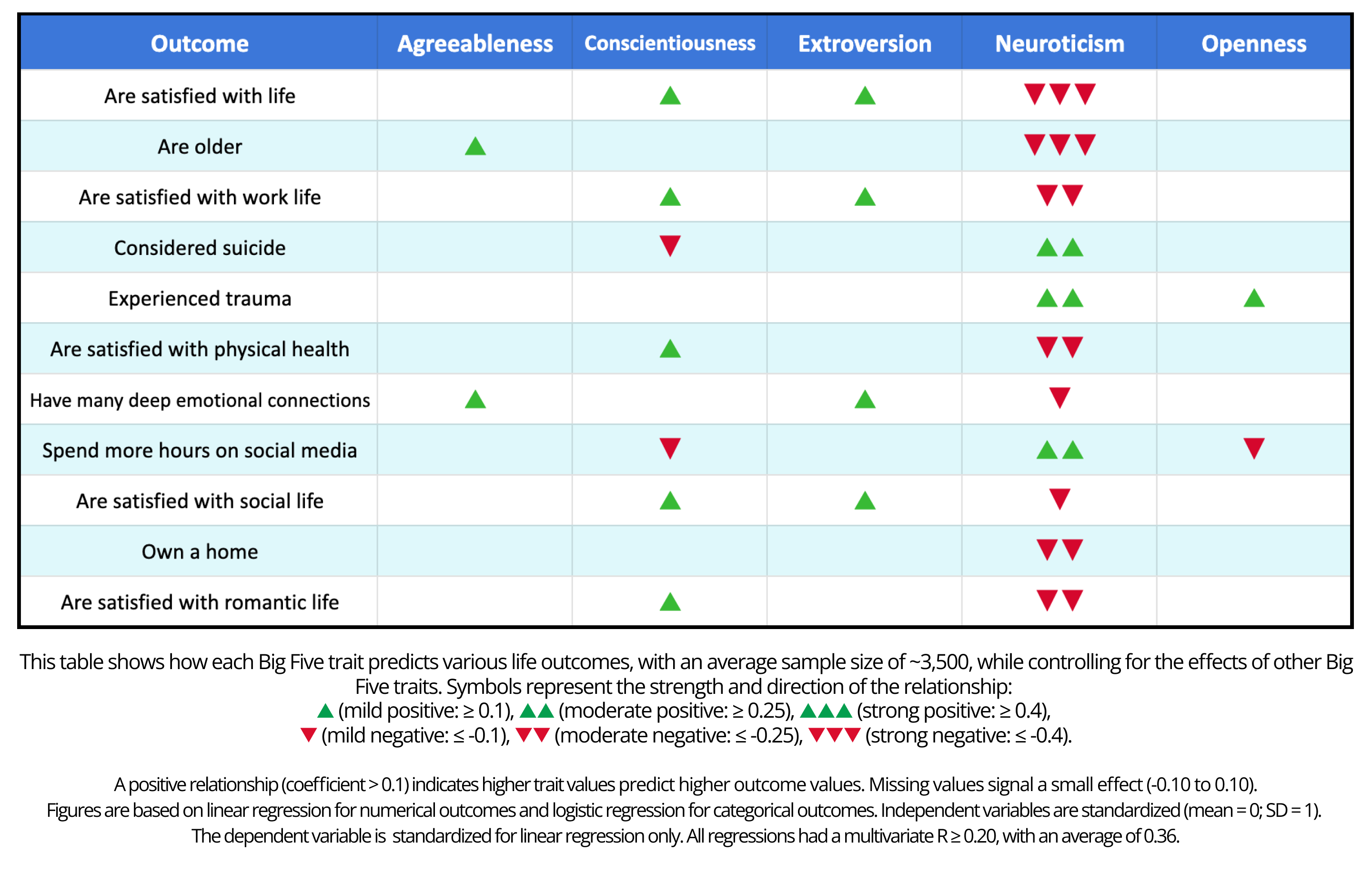
Personality significantly shapes your career, relationships, and well-being. For example, our study shows that certain Big Five traits — high Extraversion, high Conscientiousness and low Neuroticism — are linked to higher life satisfaction. Our report explains in detail the impact of the Big Five on our life outcomes list.