
The Ultimate Personality Test
Where Science Meets Self-Discovery
Get insights and personalized recommendations from 4 personality frameworks in one scientifically-designed test. Discover your Big Five, Enneagram, Jungian Type (Briggs/Myers style), and Personality Cluster.
100% free • Instant results
What Makes This Test Special?
Get comprehensive insights from the four most comprehensive personality frameworks in psychology.
Scientifically Designed
Based on data-driven psychological research and tested with 300,000+ participants
Compare with Friends
Share results with friends for detailed personality comparisons
Personalized Insights
Get tailored recommendations for career, relationships, and personal growth.
Watch our founder break down the psychological research that inspired our unique four-in-one personality test.

Four Frameworks. One Complete Picture.
The three most popular personality frameworks in psychology, plus our exclusive new framework.
Big Five
The gold standard in academic psychology. Measures your levels of Openness, Conscientiousness, Extraversion, Agreeableness, and Neuroticism.
Enneagram
Explores nine personality types based on core motivations and fears. Popular for personal development and self-understanding.
Jungian Type
Inspired by MBTI, categorizes personalities across four dimensions: Extraversion/Introversion, Sensing/Intuition, Thinking/Feeling, Judging/Perceiving.
Personality Cluster
Our exclusive framework. Categorizes you into one of our 16 unique personality types based on statistical analysis.
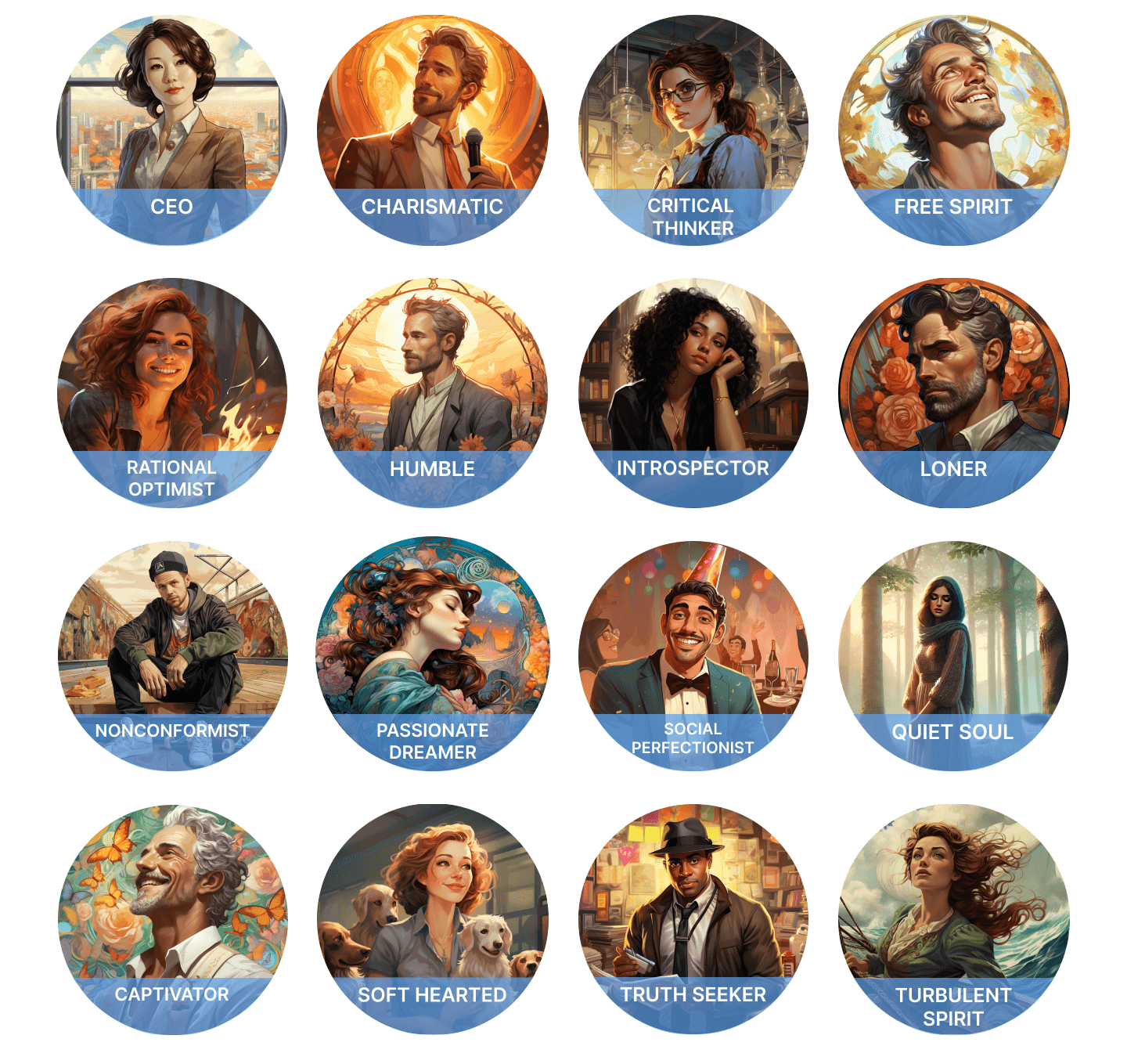
Meet Your Potential Personality Types
Our exclusive Personality Cluster framework identifies you as one of these 16 unique types:
By proceeding you're agreeing to our TOS and Privacy Policy. Click here to learn more.
As you make progress through our programs, we save data about your choices for you in our database. We will never share data about your usage of our programs in combination with any of your personally identifying information, unless you explicitly give us permission to do so. We may use some data in aggregate – that is, in combination with other user information without any means of identifying you specifically – for research purposes. For example, we may use your fully anonymized data (aggregated with data from other users) as part of a research study which we may release or publish the results of.
If you are too young to agree to our Terms of Service or Privacy Policy in your country (under 16 in the European Region), please ask your guardian to click the button below on your behalf before continuing to use ClearerThinking.org.
Some third party companies that perform automated services for us (e.g. Google, as part of their Google Analytics service) may store your personal information, but they do not have permission to use or disclose this information for any purpose other than to render their services to us.
E.U. Citizens: Please note that your data will be stored outside of the European Union, including potentially in the U.S. and in other countries where we may have servers or databases.
For privacy and usage details, please check out our Terms of Service and Privacy Policy .
If you would like a copy of the information collected during your use of one of our programs, or would like to request that we delete your data for that program, please email us at info@clearerthinking.org and indicate the name of the program you used, along with sufficient information enabling us to identify which user is you (so we can provide or delete the correct data).
Last updated: May 25th, 2024.
Ready to Discover Your Personality?
Join over 300,000 people who have already uncovered their unique personality insights. Your journey of self-discovery starts here.
100% free • Instant results
More about Personality Tests and Personality Charts
Personality tests explained: what the Big Five, MBTI-style and Enneagram frameworks measure, which personality test is most accurate, how many personality types there are, and what our research found.
What are the most famous personality tests?
The top three most globally-recognized general personality frameworks are:
- MBTI (Myers-Briggs Type Indicator): with over 30 million Google search results
- Enneagram: with over 11 million search results
- Big Five: with over 4 million search results.
Is there a truly free personality test?
Yes. The Ultimate Personality Test on this page is free, takes about 12 minutes, and reports your Big Five trait scores, your MBTI-style (Jungian) type and your Enneagram type in one sitting. Free is the norm for two of the three frameworks: there is no official Big Five or Enneagram test you have to pay for. The exception is the Myers-Briggs Type Indicator, which is proprietary (see "Is there an official MBTI test?" below), so every free "MBTI test" online, ours included, is an MBTI-style approximation rather than the official instrument. More on the three frameworks and their types.
What is the MBTI?
The MBTI is an extremely popular personality test that classifies people into 16 types, based on how they perceive the world and make decisions. This test divides each person along four binary dichotomies:
- Extraversion (E) vs. Introversion (I)
- Sensing (S) vs. Intuition (N)
- Thinking (T) vs. Feeling (F)
- Judging (J) vs. Perceiving (P).
What are the personality types in this system? Each trait contributes a letter to a person's type, leading to 16 total types of personalities:
- ISTJ - The Inspector
- ISTP - The Crafter
- ISFJ - The Protector
- ISFP - The Artist
- INFJ - The Advocate
- INFP - The Mediator
- INTJ - The Architect
- INTP - The Thinker
- ESTP - The Persuader
- ESTJ - The Director
- ESFP - The Performer
- ESFJ - The Caregiver
- ENFP - The Champion
- ENFJ - The Giver
- ENTP - The Debater
- ENTJ - The Commander.
Is there an official MBTI test?
Yes. The Myers-Briggs Type Indicator is a proprietary assessment owned by the Myers & Briggs Foundation and administered by certified practitioners. Free online "MBTI tests", including the Jungian type in our test, are unofficial MBTI-style versions written to measure the same four dimensions. We checked ours against people's own results: among 118 test takers who knew their MBTI type, our scores matched the individual letters 72 percent of the time, about three of four letters per person. More on official and MBTI-style tests.
Has Myers-Briggs been debunked?
Not in the sense of being worthless, but it does not hold up as well as its popularity suggests. Peer-reviewed critiques point to weak test-retest reliability (many people get a different type when they retake it) and to the forced either/or letters. In our study an MBTI-style type predicted life outcomes about half as well as the Big Five, though far better than astrology, which predicted nothing at all. The four dimensions do track real traits: the extraversion, intuition and feeling scales line up with Big Five extraversion, openness and agreeableness. An MBTI-style type is a simplified and more flattering reading of traits the Big Five measures more precisely. What the research says about MBTI-style tests.
What is the Big Five?
The Big Five is the leading personality framework used by social scientists and psychologists in academia. It scores people on five traits:
- Openness — related to being imaginative, creative and intellectual
- Conscientiousness — about being orderly, organized, hard-working and rule abiding
- Extraversion — on being social, friendly, energetic, and talkative
- Agreeableness — about being kind, empathetic, people pleasing and polite
- Neuroticism — related to being anxious, depressed, angry, emotionally volatile, and having low emotional-stability.
To develop the model, researchers compiled many descriptive words, such as "kind" and "anxious". They then used factor analysis to cluster similar words based on correlation (i.e., if you agreed that one word described you, you were likely to agree that another word did too). For example, since "outgoing" people also tended to describe themselves as "talkative", those terms were linked (due to this correlation) under the broader trait of Extraversion.
Is MBTI or Big 5 more accurate?
The Big Five, by a wide margin in our data, for two reasons. MBTI-style tests leave out neuroticism, and dropping that one trait from the Big Five cut its predictive accuracy by 22 percent in our study. They also sort you into one of two letters on each dimension, while our data show most traits form a bell curve with most people near the middle, so a letter throws away information that a score keeps. Combining Big Five and MBTI-style results predicted nothing that the Big Five alone did not. People do like MBTI-style reports more: 19 percent said the Big Five report did not make them feel good about their personality, against 10 percent for the MBTI-style report. The key findings in brief.
What is the Enneagram?
The Enneagram classifies people into nine interrelated types, each identified by a number and defined by unique motivations and fears. Developed in the 20th century by Bolivian philosopher Ichazo and Chilean psychiatrist Naranjo, the Enneagram is not widely used in academia, but many people report finding it a useful tool for self-reflection. The Enneagram is not to be confused with the "12 personalities test", as it uses nine categories, not twelve.
The nine Enneagram types are:
- Enneagram Type 1: The Reformer — they are thought to be orderly, conscientious, and neat. Think Angela Martin from the TV show the Office. This type is sometimes linked to Obsessive Compulsive Disorder (OCD).
- Enneagram Type 2: The Helper — they are thought to be kind, nurturing, empathetic, and never cruel. They often focus on relationships, where they may find it challenging to say no. Think Leslie Knope from the TV show Parks and Recreation. This type is sometimes linked to Dependent Personality Disorder.
- Enneagram Type 3: The Achiever — they are thought to be charming, socially confident, ambitious, and hard-working, but also potentially shallow and attention seeking. Think Gaston from Beauty and the Beast. This type is sometimes linked to Narcissistic Personality Disorder.
- Enneagram Type 4: The Individualist — they are thought to be artistic, poetic, creative, sensitive, self-critical, and full of intense emotions. Think Zuko from the Last Airbender. This type is sometimes linked to Borderline Personality Disorder.
- Enneagram Type 5: The Investigator — they are thought to be logical, intellectual, curious, and learning-oriented, but also can be unexpressive, monotone and can have obsessive focus on solo hobbies. Think Sherlock Holmes. This type is sometimes linked to Schizoid Personality Disorder.
- Enneagram Type 6: The Loyalist — they are thought to be shy, loyal, awkward and insecure. They may feel beholden to the opinion of others and fear being taken advantage of. Think Cogsworth (the butler turned into a clock) from Beauty and the Beast. This type is sometimes linked to Paranoid Personality Disorder.
- Enneagram Type 7: The Enthusiast — they are thought to be extroverted, playful, and chatty. While they may be playful and spontaneous, they can also be uninhibited and have trouble making decisions. Think the Genie from Aladdin. This type is sometimes linked to Histrionic Personality Disorder.
- Enneagram Type 8: The Challenger — they are thought to be assertive and leader-like. While they tend to take charge and not shy away from disagreements or arguments, they may also be assertive, cocky or bossy. Think Scar from The Lion King. This type is sometimes linked to Antisocial Personality Disorder (sociopathy or psychopathy).
- Enneagram Type 9: The Peacemaker — they are thought to be passive, conflict avoidant and avoiding standing out. They are also cooperative, non-competitive, and prone to assist others. Think Dr. Watson from Sherlock Holmes. This type is sometimes linked to Avoidant Personality Disorder or Social Anxiety Disorder.
Which is the most accurate personality test?
If accuracy means how well a result predicts real life, the Big Five wins. We gave 559 US adults tests built on the three most popular frameworks and used each one to predict 37 life outcomes, from life satisfaction to exercise habits. The Big Five predicted them about twice as accurately as a four-letter MBTI-style type, and the Enneagram came in between. A follow-up with roughly 3,500 test takers and 30 outcomes gave the same ranking. That is why the Ultimate Personality Test reports Big Five scores alongside your Jungian and Enneagram types. Read the full study, or our summary of it in Scientific American.
Are personality tests accurate?
Some are, and what matters is the framework, not the branding. Scores beat types every time: converting any framework from types to continuous scores raised its predictive accuracy in our data, and converting the Big Five into types lowered it. Personality also predicted happiness and life satisfaction better than IQ did. A good test tells you where you sit on each trait, not only which box you fall in. Personality versus IQ as a predictor.
How does personality influence your life?
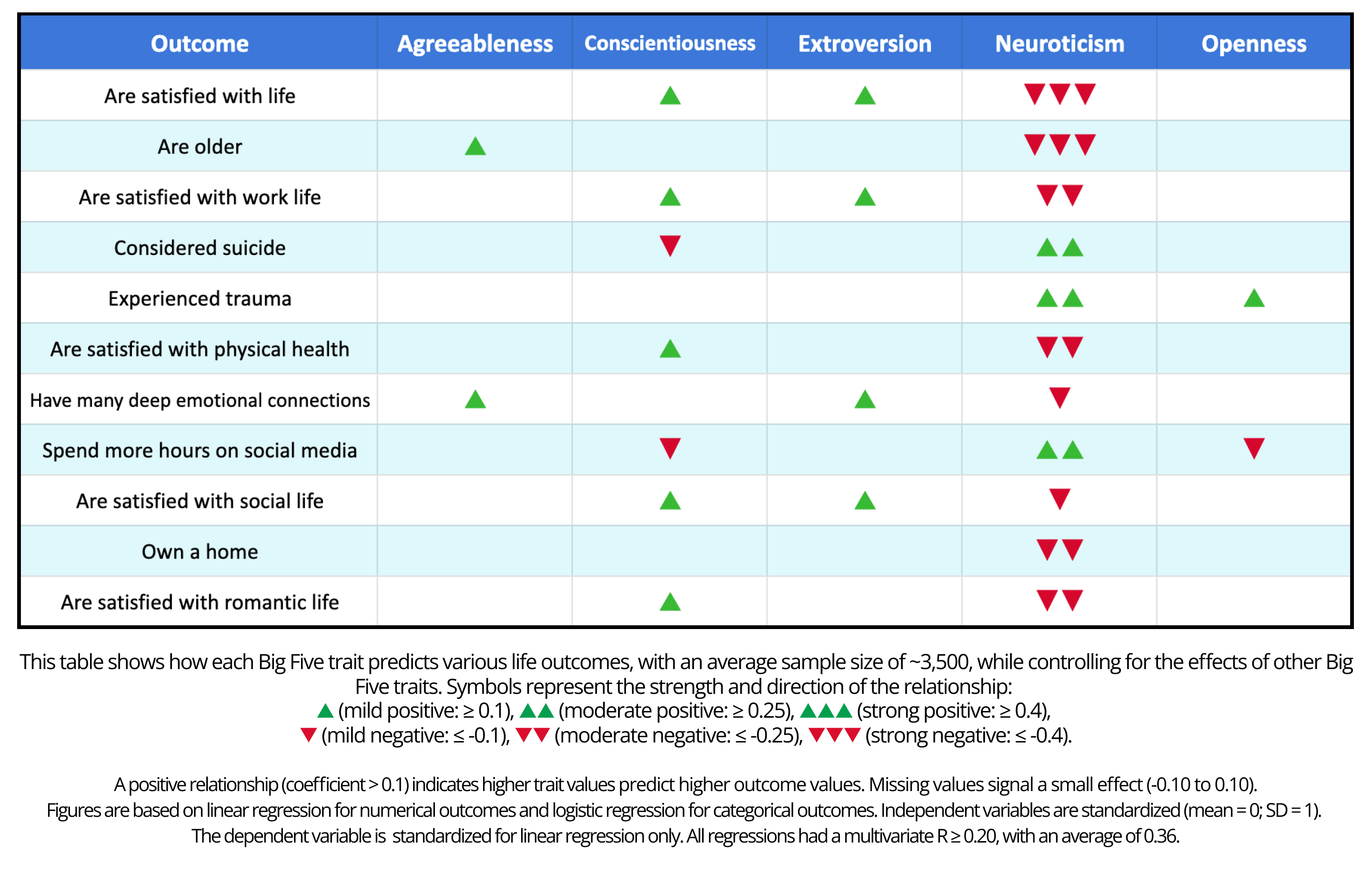
Personality significantly shapes your career, relationships, and well-being. For example, our study shows that certain Big Five traits — high Extraversion, high Conscientiousness and low Neuroticism — are linked to higher life satisfaction. Our report explains in detail the impact of the Big Five on our life outcomes list.
What is my personality type?
The only way to know is to take a test, and the answer depends on the framework: a four-letter MBTI-style type, an Enneagram number from 1 to 9, or a Big Five profile of five trait scores. Use a test that shows your score on each trait rather than a label alone, because most people sit near the middle of each trait and a label hides how strong a lean is. The Ultimate Personality Test gives you all three in about 12 minutes, plus one of 16 Clearer Thinking types derived from test takers' answers rather than from theory.
How many personality types are there?
It depends on the model. MBTI-style tests have 16 types, built from four either/or letters. The Enneagram has 9. The Big Five has no types at all: it scores five traits on a continuous scale, so there are as many profiles as there are people. Our own system has 16 types, found by running a cluster analysis on test takers' answers so that people in a group answered alike and differently from the other groups; the names and descriptions were written afterwards to fit each cluster. In our data a 16-cluster type predicted life outcomes better than MBTI-style or Enneagram types, but not as well as Big Five scores. The full list of types in each system.
What is the rarest personality type?
There is no stable answer, because "rarest" depends on which test and which sample you count. Published rarity rankings come from the test publishers' own samples, and in letter-based systems a type's share changes with the sample and with where the test draws the line between two letters. Our data show that most traits form a bell curve, with most people close to the middle, so whether someone counts as a rare type can hinge on one or two answers. A score on each trait tells you more about yourself than a rarity ranking does. How traits are distributed in our study.
Am I an INFJ or INTJ?
The two types differ on one letter, Feeling versus Thinking: whether you make decisions from personal values or from objective analysis. If you keep landing on both, you are probably near the middle of that dimension, which is where most people sit in our data. A test that scores each dimension, instead of only assigning a letter, shows how strong your lean is. In our study the Thinking versus Feeling scale lined up with Big Five agreeableness, so your agreeableness score is a second reading on the same question. The Ultimate Personality Test reports both. What each MBTI-style letter means.